







And now, let’s look ahead
September always arrives with the promise of a new beginning. Shop windows change, collections change, agendas change and, at least in our intentions, we change too.
But for eyewear, September means something more: it is the moment when a new season takes shape and the future stops being an abstract word, presenting itself without asking for permission. We will see it at trade fairs, in the corridors, in the booths, in the collections and in the conversations at Silmo Paris, CiOF Beijing and DaTE. Different places, different markets, different sensitivities, but one shared evidence: the future is no longer beyond the horizon. It is already in front of us, and it asks us to change the way we look at things.
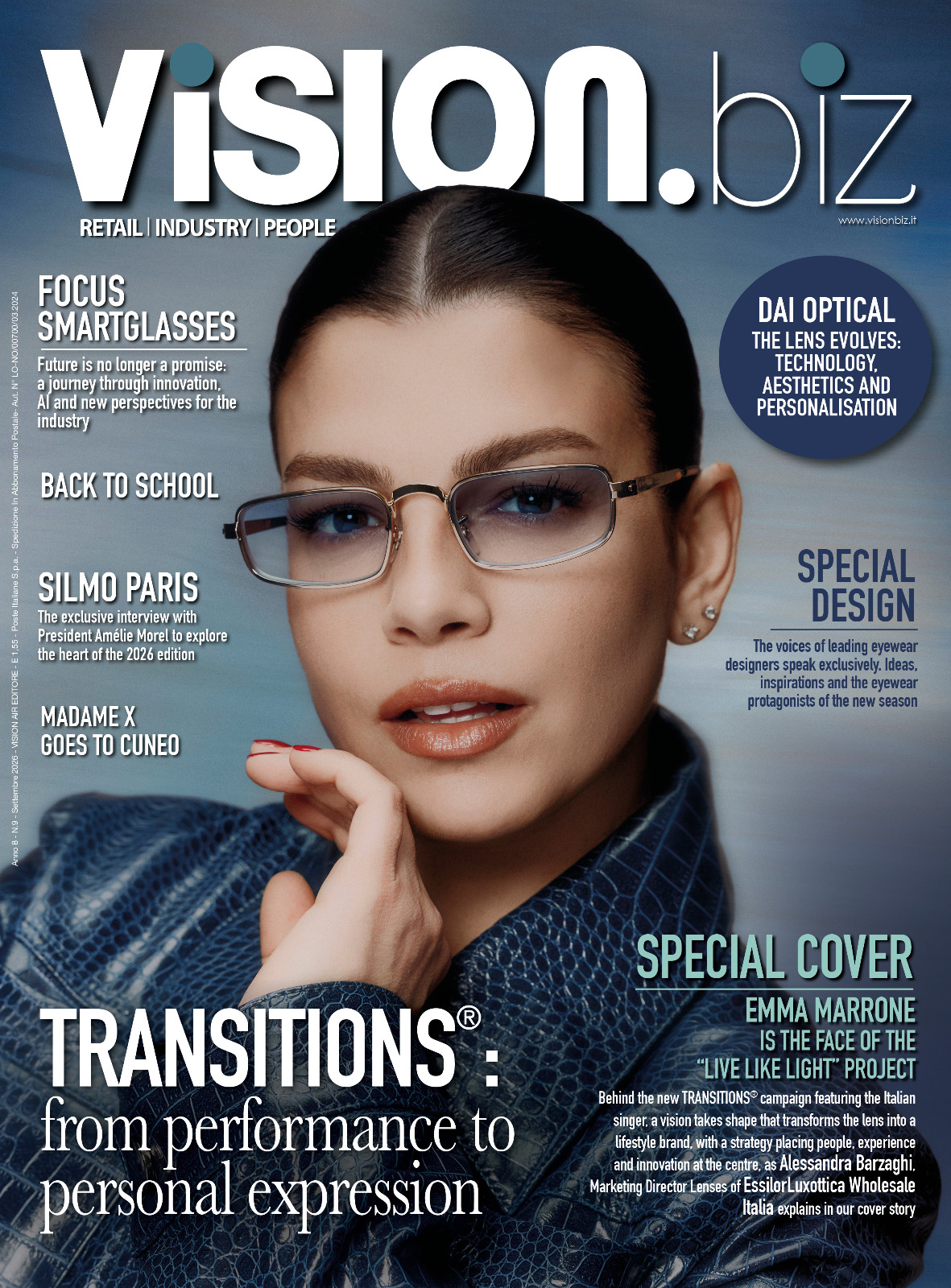
And this is precisely why we have chosen to dedicate our focus to smart glasses, to tell the story of a transformation that no longer belongs to a distant future, but has already entered the market and, increasingly, consumers’ daily lives.
The question, then, is no longer: “What will the eyewear of the future look like?” The right question is: “Are we ready to sell what the future has already become?”
Because smart glasses are already here. Artificial intelligence is already here. They have entered the eyewear ecosystem, challenging a definition of glasses that for decades seemed definitive. Glasses are no longer just a frame supporting a lens. They are an object that integrates functions, connections, information and intelligence. They are a point of contact between people and the world around them. And the lens, from a passive optical element, is already involved in an ecosystem where adaptation, protection, information and interaction coexist. An ecosystem that, in perspective, will be able to take on an increasingly important role also in the fields of health and prevention.
It is an enormous paradigm shift, and the transition is far from theoretical because it is already right in front of consumers’ eyes.
And here comes the most interesting part, the one that directly concerns our world: what does all this mean for opticians?
It means a commercial opportunity. But also a responsibility.
Because smart glasses are not sold like a technological gadget. They are worn on the face, they must be comfortable, they must fit properly, they must respond to individual needs. They have a direct relationship with vision and with the body. And above all, they require someone capable of explaining not only “what they do”, but “why they can be useful to that specific person”.
This is where opticians have an extraordinary competitive advantage compared to any other channel. They know the face. They know vision. They know fitting. They know their customers’ habits. They know how to read a need and transform it into a solution. Now they must add one more skill: knowing technology well enough to make it simple. It is not a small step. It is a new business opportunity.
The same applies to artificial intelligence. Continuing to describe it as a threat means looking at only half of the story. AI is changing processes, automating activities, accelerating operations and reshaping certain professions. But precisely for this reason, it frees up time, skills and energy that can be redirected towards what no algorithm can replace with the same effectiveness: relationships, experience, consultancy, creativity and the ability to understand people.
The real challenge, therefore, is not working less thanks to AI. It is using AI to increase the value of what we do.
More productivity means better service. More precision. More personalisation. More time for customers. And also new skills and new roles. Because every technology that eliminates part of the work creates new ones, if we have the ability to recognise them.
But precisely while technology accelerates, one word returns to the centre stage: design. Because the smarter eyewear becomes, the more important it is that it knows how to simply be… a good pair of glasses.
It may seem like a paradox. It is not. A camera, a sensor, a microphone, a battery or an AI system can make a frame technologically advanced. But if it is heavy, slips, feels tight, does not fit well or is not appealing, everything else loses value. Technology does not eliminate the body. On the contrary, it makes it even more central. Because no artificial intelligence will ever erase the fact that a frame must look good on a face. It must be comfortable. It must fit properly. It must respect proportions, balance, materials and ergonomics. And, naturally, it must be desirable.
This is where design meets its most difficult challenge. Designing eyewear today means dealing with greater complexity: it is not enough to create a recognisable, beautiful and contemporary shape. It is necessary to design an object that integrates a function without being dominated by that function. Creativity, therefore, is not free to run on its own. It must accept a constraint. Or rather, it must transform that constraint into a project.
And this is precisely what emerges from the words of the seven designers we interviewed for our special feature. Seven different perspectives, but united by one awareness: eyewear is not a simple formal exercise. It is an object that must work before it can be told.
After all, this has always been its strength. Eyewear is one of the most personal objects that exist. It sits on the face, changes the way we look, tells who we are. Now it adds a new dimension: it interacts with us and with the world.
Perhaps this is precisely the most fascinating challenge awaiting us in the new season: not choosing between aesthetics and technology, between emotion and function, between tradition and innovation. But succeeding in making them coexist.
Because the future of eyewear will not be one in which technology replaces design. It will be one in which technology has finally learned to speak the language of design.
And so, yes, September can truly be a new beginning. Not because the future is coming. But because, if we look closely, the future is already here. The new season has already begun. Now it is up to us to decide how far we want to look.
Daniela Basilico